

Case Clicker
Burger Clicker
Click To Continue 2

Clicker Heroes

Doggo Clicker

Coin Clicker

Muscle Clicker


















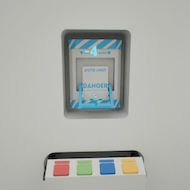
Click To Continue puts you in a white room with a single button and a number above a locked door counting down from one million. The premise sounds like parody — a decremental clicker where pressing the button reduces a count rather than raising it — but within the first few minutes the room starts revealing what it actually is: a puzzle game wearing clicker clothes. Every panel on the four walls unlocks as you accumulate clicks, and those panels contain mini-games, skill challenges, and a central hacking terminal that ties everything together. The pep talk banners, the cheerful wellness check-ins mounted on the walls, the omnipresent camera blinking red — all of it establishes a corporate hellscape aesthetic that players consistently compare to GLaDOS-era absurdist humor.
New players almost always misread Click To Continue as a passive incremental game. The first thing you do is press the button. The count drops by one. You unlock the Auto Unit, which presses the button for you, and its bonus goes up each time you win the Simon Says-style mini-game that periodically interrupts the automation. So far, familiar idle-clicker territory. The mistake is treating the panels as bonus content that unlocks between button presses. They are the actual game, and the button is just the mechanism that opens the door to them.
Each panel on the wall counts down its own number to zero as you click. Once unlocked, a panel might give you a multiplier — the pep talk signs that increase clicks-counted-per-click are the most immediately useful of these — or it might present a challenge that requires genuine attention. Puzzles in Click To Continue demand pen and paper more than once. Players who expect a casual experience and suddenly find themselves deciphering codes using environmental cues and a bit of arithmetic are usually the ones writing the most enthusiastic community posts about it.
The central computer terminal is where everything converges. It lets you hack and manipulate the parameters of each panel puzzle, and getting the Total Hackquisition achievement — which requires hacking every available device — involves understanding how the terminal’s codes interact with individual panel states. This is not something you stumble through by clicking faster. It requires reading what the room is telling you.
The most common mistake is neglecting the Auto Unit bonus. When the Simon Says prompt appears and flashes green on success, your Auto Unit modifier increases by one. Many players deliberately fail it or ignore it entirely once automation is running. The modifier resets to zero when you mess up, but the window where it applies still generates a significant click burst — players who consistently pass the sequence end up reducing the counter far more quickly than those who treat it as background noise.
The second mistake is ignoring the DAR form. The DAR (Daily Activity Report) is a periodic wellness check-in the room presents to you, and answering it correctly earns the Administrative Apex achievement. The correct responses are specific and non-obvious on first read. Players who approach it like a joke form and click through randomly find it unsatisfying; players who treat it seriously — reading the options carefully — often discover it is one of the funnier bits of writing in the game.
The coffee machine robot sequence is a recurring element that causes brief freezes in some runs. It resets on its own timer every few minutes. If the game appears to have locked up, this is almost certainly the cause. Waiting it out rather than force-closing saves considerable progress.
The terminal in the center of the room is the most divisive element in Click To Continue. Some players love that a game presenting itself as a corporate clicker suddenly demands pen-and-paper puzzle solving. Others — particularly those who came in expecting something low-stakes — find the hacking sequences stressful or opaque. The grid puzzle, which requires inputting push orders in a specific sequence, is the most frequently searched topic in the Steam guide section, which gives a sense of how many players hit it and immediately feel lost.
What the terminal is actually doing is functioning as a meta-layer over all the individual panel challenges. Once you understand that the hacking codes modify the behavior of what those panels require, the room starts to feel like a designed system rather than a collection of disconnected bits. The moment that clicks — usually somewhere in the middle of a run, when you realize you have been changing the rules of a puzzle you have already solved — is the one players specifically mention when recommending the game.
The OmniPress, which you can activate up to twenty times (and which has its own Steam achievement for doing so), functions as a rapid-click multiplier that the terminal can interact with. Using it during a well-prepared hack window is the kind of technique that separates a casual run from a confident one.
Click To Continue has a meaningful achievement list that rewards engagement with all of its systems rather than just grinding the door count down. The speedrun achievement asks you to finish the game in under two hours, which is genuinely difficult without understanding the terminal and panel layout — players who attempt it blind on their first run typically succeed only by looking up the grid puzzle push order. The achievement for stealing the golden button requires discovering a specific environmental interaction that is not hinted at directly. Standing on the VacuumBot for a full minute is the kind of thing you only do if you notice the VacuumBot exists as something more than furniture.
Click counts have their own milestone achievements at 777, 2048, 7777, and 9999. These accumulate naturally during a full run but serve as gentle pacing markers for how much time you have spent in the room. Players who hit 9999 and have not yet opened every panel are almost certainly missing something in the hacking layer.
The community has organized guides around three main areas of confusion: the hacking codes for the terminal (which are consistent across runs and have been compiled into a full list), the grid puzzle push order, and the DAR form responses. All three exist on the Steam guides page in detail. Searching “Click To Continue hacking codes” or “Click To Continue DAR form answers” will land you at reliable player-written documentation within seconds.
The most honest thing to say about Click To Continue is that it does not clearly communicate what it is. The Steam page describes a surreal clicker with humor and mystery. This is accurate but incomplete. A meaningful portion of the game requires the kind of focused puzzle-solving that some players — especially those coming from idle or casual clicker backgrounds — do not want from a two-hour session. Reviews that express frustration almost always cite the grid puzzle specifically, or the terminal’s opacity in the early stages before its purpose becomes clear.
This is not a flaw in the design so much as a mismatch in expectation. Players who enjoy absurdist puzzle games with a dry corporate sense of humor tend to rate it very highly. Players who wanted a comedy clicker and got a comedy puzzle-clicker are the ones leaving the mixed reviews. Knowing which of those you are before starting will tell you exactly how you will feel about the room.
The grid puzzle requires you to press the panels in a specific order rather than in any intuitive spatial pattern. The push order has been documented by the Steam community in a widely linked guide titled simply “Grid Puzzle” by Crast. The puzzle does not respond to trial and error well because incorrect sequences reset your progress within that panel. Looking up the documented order is the intended path for most players; the puzzle is testing whether you can follow a precise sequence, not whether you can deduce it from scratch.
The terminal connects to every hackable device and panel in the white room, allowing you to modify their parameters — effectively changing the rules of individual puzzles once you know the correct code for each device. Using the terminal strategically unlocks the Total Hackquisition achievement, which requires hacking all available devices in a single session. The codes are consistent across runs and have been fully compiled in community guides. Understanding the terminal’s relationship to the panels transforms Click To Continue from a clicker with puzzles scattered around it into a unified system where everything connects.
Yes, and there is a Steam achievement for it. The key is understanding the Auto Unit bonus system — consistently passing the Simon Says sequence rather than ignoring it — and using the OmniPress at the right moment in the terminal sequence. Knowing the grid puzzle push order and the DAR form responses ahead of time eliminates the two biggest time sinks for new players. Experienced players have completed the run in under twenty minutes in documented speedruns, though sub-two-hours is the target for the achievement.
Click To Continue earns its reputation by being something different from what the first five minutes suggest. The white room, the blinking camera, the VacuumBot tracing its little patrol route across the floor — these are set dressing for a puzzle system that takes itself seriously even while the pep talk banners refuse to. Players who reach the door and see the count finally hit zero will recognize that the journey through the panel layer, terminal codes, and the DAR form’s pointed questions was the point all along, not the clicking.
