

Case Clicker
Burger Clicker
Click To Continue 2

Clicker Heroes

Doggo Clicker

Coin Clicker

Muscle Clicker



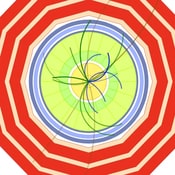

















What happens when you click the CMS detector and nothing seems to change? Early in Particle Clicker, that is the honest answer — you accumulate a few dozen data points, your reputation is zero, and the grant money needed to hire a PhD student looks like it belongs to a different game entirely. Most players who bounce off the game leave in this window, before the research loop clicks into place. Players who push through discover that the entire economy of the lab shifts not when you click faster, but when you finally fund your first piece of published research.
Particle Clicker was built at CERN’s 2014 Webfest hackathon in 48 hours by a team of five students, and the educational skeleton is visible in everything. The core interaction is clicking a stylized image of the CMS detector — the same detector at the Large Hadron Collider that contributed to the Higgs boson discovery — and each click simulates a particle collision that produces data. Data is the primary currency, and everything else flows from it: you spend data on research, research yields reputation, reputation attracts grant money, grant money pays for workers, and workers produce data passively.
The loop is a deliberate simulation of how academic science actually works. A student clicks until they can publish a paper; the paper builds their reputation; the reputation attracts funding; the funding hires more people. Particle Clicker maps this career arc faithfully enough that the game was held up in physics education circles as an unusual success — an incremental game that sneaks real content into its upgrade descriptions without feeling like a lesson. When you unlock CP violation research and the description references James Cronin and Val Fitch’s Nobel Prize, it lands as flavor text that earns its place rather than padding.
The data-click upgrades follow a clear priority path. The community consensus, developed through automator scripts and manual testing, is to prioritize the +4, +12, and +42 data-per-click upgrades first, then acquire all three x3 multipliers. Chaining those three multipliers against the additive bonuses produces 1,593 data per click — a number cited in forum threads often enough that it functions as a benchmark. Players who hit this threshold before investing heavily in the HR tab find their passive income ramps significantly faster in the mid-game.
The research tab in Particle Clicker is where the game’s educational intent shows most clearly. Discoveries follow a rough chronological order through particle physics history. Early research involves relatively accessible phenomena; as reputation grows and grant money scales, experiments push toward the Higgs boson, the game’s terminal milestone. Players who have even a passing familiarity with the Standard Model will recognize the progression. Players without that background still follow it comfortably, though the in-game write-ups assume more prior knowledge than the average casual gamer brings.
Each research entry becomes progressively more expensive in data terms, which mirrors a real aspect of scientific progress: discovering something about a well-studied phenomenon requires far more experimental evidence than the first person to describe it did. The game uses CP violation as its explicit example of this scaling. Once a discovery has been published, repeating it yields diminishing reputation returns. This discourages grinding a single research area and pushes players outward into the discovery tree, which is the intended behavior.
The HR tab is where strategic depth lives. The worker types in Particle Clicker scale from PhD students through postdocs and research fellows up to tenured professors, Nobel Prize winners, and — most productive according to the game’s own data rates — summer students. That last detail is an inside joke familiar to anyone who has worked in a research institution: summer students, unpaid or cheaply paid, generate disproportionate output. Players who skip the summer student tier in favor of immediately expensive workers consistently find their data-per-second lower than it should be at equivalent budget levels.
Particle Clicker has a well-documented late-game problem that the community discusses openly. After one to two hours, the rate of new discoveries and upgrades slows considerably. Hiring new workers and funding experiments becomes expensive enough that the primary activity shifts from active decision-making to waiting. Waiting around for the Higgs boson to appear is the game’s own anticlimactic conclusion — several players use exactly those words in reviews and forum threads. The game builds toward its most significant real-world discovery and then delivers it as an idle reward rather than a meaningful climactic moment.
The game’s educational text is also not uniformly accessible. Some descriptions use terminology that assumes a physics background, and not all the concepts link out clearly enough for a complete beginner to follow without opening separate tabs. Players who came for the clicking and stayed for the science sometimes find themselves scratching their heads at references to the W and Z bosons or bottom quarks without enough context to make the information stick. This is a genuine tension in Particle Clicker’s design: it is educational but does not quite decide how educational it wants to be.
One detail that only emerges from actually playing is the moment when the event display fires during a click and the particle shower scatters across the detector image. On slower hardware that animation can visibly tax performance — the game notes that event display rendering relies heavily on available resources — and on some machines it becomes a background flicker rather than the satisfying visual payoff it is supposed to be. Players on modest setups often turn the display off entirely and lose one of the game’s most distinctive feedback moments.
The most common beginner mistake in Particle Clicker is hiring expensive workers before the research tree can support them. A tenured professor costs significantly more than a postdoc and produces correspondingly more data per second, but if your reputation is not yet high enough to unlock the mid-tier experiments that convert that data into grant money, you stall. The correct sequencing is to keep research pace ahead of HR investment — spend on experiments until they unlock a new HR tier, then hire into that tier, then return to experiments.
The x3 multiplier upgrades are frequently deprioritized by new players who assume the additive +N upgrades are more straightforward investments. The math runs the other way. Once you have all three additive bonuses active, each x3 multiplier triples the entire stack, not just the base click. Players who sequence additive before multiplicative upgrades are leaving exponential gains sitting in the shop. The community shorthand for this ordering mistake is “stacking wrong,” and it appears in almost every beginner question thread.
For players who engage with the game as a science lesson as much as a clicker, the Hacker News thread from 2014 remains one of the more interesting artifacts — players discussing whether data should be siloed by research area rather than pooled universally, and whether using the same data points to research both W and Z bosons and the bottom quark felt physically meaningful. The game never changed its pooled-data model, but the question itself reflects the unusual position Particle Clicker occupies: a game literate enough in its subject that its players debate its accuracy.
Prioritize the additive data-per-click upgrades in sequence — the +4, +12, and +42 bonuses in that order — before purchasing the x3 multiplier upgrades. Once you hold all three additive bonuses, each x3 multiplier triples the combined total rather than just the base click value. Acquiring all three multipliers after all three additive upgrades produces 1,593 data per click, which is the benchmark most routing discussions use as a mid-game target. Do not spend grant money on additional workers until this threshold is reached, or your passive income will lag behind your click income for longer than it needs to.
Each research entry in Particle Clicker costs exponentially more data than the previous one in the same discovery area, and the reputation gains per experiment decrease once a phenomenon is well-studied. This is a deliberate design choice mirroring real academic research economics. The practical consequence is that after the initial burst of discoveries — roughly the first ninety minutes — the game enters a passive accumulation phase where waiting replaces active decision-making. Hiring summer students ahead of more expensive worker tiers can partially offset this slowdown, as their data-per-second-per-cost ratio outperforms most mid-tier workers.
Yes, the particle shower animation that fires on CMS detector clicks is hardware-dependent and can visibly degrade frame rate on lower-spec machines. The game’s own documentation notes that event display performance relies heavily on available hardware resources. The display can be toggled off in the game’s settings without affecting any data or reputation mechanics — it is purely visual feedback. Players on older hardware or those playing on battery often disable it early and report no functional difference in progression, only the loss of the collision visualization.
Particle Clicker earns its place in the history of educational browser games not because the physics lessons are seamlessly integrated — some of the research descriptions will lose casual players — but because it makes the actual structure of a particle physics career feel like something worth simulating. By the time you are managing PhD students, postdocs, and summer students while waiting for the Higgs boson to confirm itself through accumulated data, the CMS detector on screen has stopped looking like a game asset and started looking like a job you chose.
