


Case Clicker
Burger Clicker
Click To Continue 2

Clicker Heroes

Doggo Clicker

Coin Clicker

Muscle Clicker




















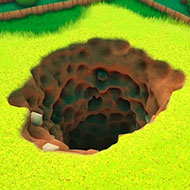
You start A Game About Digging A Hole by reading a poster nailed to a board outside a newly purchased house: a big red X marks where the treasure is buried in the back garden. That setup takes about thirty seconds. Then you pick up a shovel and start digging straight down. The entire game lives inside that loop — dig, collect ore, surface to sell, upgrade, go deeper — and it does not pretend to be anything more elaborate than that. It sold 250,000 copies in its first week on Steam and sat at nearly 7,500 concurrent players at peak, numbers that say more about the appeal of pure, unpretentious extraction than any review could.
| Genre | Minimalist mining simulation |
| Platform | PC, Xbox, iOS, Android, Nintendo Switch |
| Release | February 7, 2025 |
| Depth of main objective | Approximately 112 metres to the chest |
| Completion time | 60–90 minutes casual; under 30 minutes earns an achievement |
A Game About Digging A Hole gives you a shovel, a battery gauge, and an inventory. The shovel removes dirt. Ore appears in the dirt. You pick up the ore, your inventory fills, you jetpack or walk back up to the garage, sell the ore at the computer terminal, and spend the money on upgrades. That is the whole structure. The depth layers change what ore appears: stone and coal dominate the first twenty or thirty metres, then iron and copper start mixing in, and by the time you are pushing past fifty metres silver and gold become common. Diamond and platinum appear closest to the bottom and sell for enough to make every prior upgrade affordable in retrospect.
The garage terminal handles everything: selling ore, purchasing shovel upgrades, buying jetpack fuel capacity, expanding inventory space, and buying dynamite at $100 per stick. Dynamite is not decorative. Rock formations and lava mounds appear at mid-depth that the shovel cannot break at all, and the drill — the shovel’s fully-upgraded form — cannot handle them either. Players who ignore dynamite stockpiles and hit their first impassable rock at around forty metres are typically the ones who look up guides for the first time.
The upgrade priority that experienced players converge on is: Battery first, then Shovel to its maximum pre-drill upgrade, then Jetpack capacity, then Inventory slots. This order matters because the Battery limits how long you can stay underground per trip, the shovel’s dig radius directly multiplies progress speed, and the jetpack determines how quickly you can return to the surface to sell. Inventory management — only picking up high-value ores and leaving stone and coal behind once you are deep enough — is the efficiency skill that separates fast runs from slow ones.
The most common early mistake in A Game About Digging A Hole is digging wide instead of digging narrow. The temptation is to clear large horizontal swaths of dirt because it feels productive and exposes more ore. In practice, time underground is limited by the Battery, and horizontal movement burns that capacity without adding depth. The fastest strategy is a hole just wide enough for your character to move through, going straight down.
The second mistake is buying the Drill upgrade too early. The Drill transforms the shovel into something that deletes dirt automatically at speed, which sounds like a pure upgrade. But the Drill also disables the I AM SHOVEL achievement — which requires 4,000 manual shovel strikes — and cannot be tracked retroactively. Players who want full achievement completion on a single run need to finish all manual-shovel progress before purchasing the Drill. This is not obvious from the upgrade menu, and it is one of the most frequently asked questions in the Steam community discussions.
Third: the two keys for the locked chest in the garage. A metal detector device appears in your hand when you are near one, and the detector’s audio signal guides you toward the key’s location. Most players find both keys in the first fifty metres of depth. Missing them on the way down means backtracking, which is expensive in battery. Listening for the detector sound during normal descent finds both keys without any dedicated search.
Scattered through the dig zone are collapsed side tunnels — hidden mineshaft adits that do not appear on any map and are easy to pass without noticing. Inside them are regular chests containing money, additional lamps, and dynamite. These finds are not huge, but they provide a meaningful resource cushion during the mid-game stretch between forty and seventy metres where ore density is high but upgrade costs start escalating. Players who systematically explore horizontal passages at each significant depth tier tend to arrive at the mole cave better equipped than those who went purely vertical.
Rainbow Ore is in a category by itself. It appears at any depth, glows with shifting multicolour light, and cannot be sold. It exists solely to trigger the Rainbow achievement, and collecting five of them is the only reason to pick it up. Players who have never seen one often ask whether it is a bug or a decoration — the bright cycling colour makes it unmistakable once you know what to look for.
The money bags that spawn randomly in the dirt are the other underappreciated resource. They are not linked to ore layers or depth — they appear somewhat unpredictably — and finding one early can push an upgrade tier forward by several trips. The teleportation device, which appears after opening the secret chest, is a one-use item with unusual narrative weight. Using it has consequences. The community still debates whether those consequences constitute a second ending or simply a variant of the existing one.
At around 100 metres the dirt gives way to a cave entrance, and the game changes. The mole cave does not permit tools: no drill, no jetpack, no dynamite, no lamps. You navigate it manually in near-darkness using only movement. Two adits branch off from the main passage, and each one contains a giant mole patrolling a fixed route. The moles have line of sight — in the game’s own ironic acknowledgment — despite moles being famously blind in reality. If a mole spots you, it chases. The chase zone is bounded, and the moles stop pursuing past certain points in the tunnel, so running forward is always the correct response.
The chest at the end of the mole cave is empty. That is the ending of A Game About Digging A Hole. The house gets re-listed for sale with a new poster on the same board where you started, and the tally mark goes up by one. Players who find the ending anticlimactic are usually the ones who expected the chest to contain something proportional to the effort. Players who find it perfect are usually the ones who recognized the loop was already complete before they ever reached the bottom.
The Time achievement — finishing from a fresh start to opening the chest in under thirty minutes — is the achievement with the lowest completion rate on Steam at around 12%. It requires knowing the optimal upgrade order (Battery, Shovel, Jetpack, Inventory), digging a hole narrow enough to fall straight through for the Long Fall achievement prep, and navigating the mole cave without hesitation. Speedrunners have broken twenty minutes with practiced routes, but thirty minutes is a genuine challenge for any player unfamiliar with the game’s pacing.
The most honest criticism of A Game About Digging A Hole is that it runs out of content before it runs out of goodwill. Once you have the drill and a full battery, the descent becomes purely mechanical. The ore density is high enough that you are never starved for money, the upgrades stop requiring decisions, and the final section before the mole cave is simply time spent drilling in one direction. For a 90-minute game at a low price this is acceptable to most players. For anyone who wanted the depth to grow with the hole, it becomes noticeable around the sixty-metre mark.
The community debate around the Teleporter ending and the empty chest reflects a genuine split between players who want the minimalism respected and players who hoped the mystery hints throughout the dig — the glowing rainbow ore, the teleporter, the money bags — were building toward something more. The fact that the house sign gets a new tally mark is either a perfect deadpan joke or a disappointing non-answer, depending entirely on what you brought to the experience.
The keys for the locked garage chest are found underground, and their exact positions vary between runs — they are procedurally placed rather than fixed. Most players find them between 20 and 50 metres of depth. The metal detector activates automatically when your character is close to a key, and the strength and direction of the audio signal guides you precisely toward it. Digging horizontally toward the strongest signal is the fastest method. Both keys are typically accessible before you pass the fifty-metre mark, so checking the detector during your normal descent costs nothing extra.
Buying the Drill converts your manual shovel into an automatic drilling tool and permanently disables progress toward the I AM SHOVEL achievement, which requires 4,000 manual shovel strikes. This progress does not carry over if you start a new game in Achievement Mode — the mode unlocked after your first completion — so players aiming for full achievement completion in a single efficient run need to reach 4,000 strikes before purchasing the Drill upgrade. The Shovel can be upgraded up to four times before the $600 Drill unlock appears, and those four manual upgrades meaningfully widen the dig radius, making the delay worthwhile anyway.
The mole cave below 100 metres contains two giant moles, one in the first adit and two in the second. Both patrol fixed routes. Watching the shadows they cast on the cave walls is the most reliable way to track their facing direction when you cannot see their full bodies. Moles will only give chase if they have direct line of sight to your character, and they stop pursuing after you pass certain zone boundaries further into the tunnel — so if one spots you, sprinting toward the next passage rather than retreating is always faster. Selling all your ore before entering the cave eliminates the risk of losing inventory on a failed run.
A Game About Digging A Hole works because it never tries to be more than its name promises. The satisfying crunch of the shovel striking stone, the way Diamond ore glows faintly against the dark at ninety metres, the brief absurd panic of being chased by a giant mole through a cave with no tools — none of it requires a complicated system to land. The empty chest is waiting. The hole is not going to dig itself.
